
Tóthné Boda Éva Mária: Scenes of informal and non-formal learning among the folk craftsmen of Győr-Moson-Sopron County
Cikk letöltése: pdf2021-04-01
Abstract: Nowadays the process of knowledge acquisition in the field of handicrafts still bears the traditional solutions. The aim of my research is to present, with the involvement of folk craftsmen, the methods and procedures that make it possible to pass on the wealth of knowledge that is part of the national tradition to the younger generations. The reference area of the study is Győr-Moson-Sopron county, where I carried out a questionnaire survey and interview data collection within the framework of primary research.
Introduction
I assume that the non-formal and informal learning scenes of the county represent a rich capacity for those learning folk handicrafts. However, the currently available scenes are not utilized as much as they could be.
In my primary research, I examined the methods of acquiring and transmitting the knowledge required for performing folk crafts and small crafts, as well as the dynamics of teaching and learning. I attempt to uncover the blank spots of Győr-Moson-Sopron county in this respect and, focusing on the folk craftsmen, I am going to summarize the cadastre of the available scenes. The results of the interview-based study provide information about the motivations and ambitions of the master craftsmen and small craftsmen, and give insight into the knowledge acquisition of the studied population and their difficulties of passing on their craft. Based on these surveys, I determine the directions for further study and the areas of intervention. Finally, I will specify who should be helped and in what way in order to ensure that this Hungarian intellectual property can be safely preserved for the future.
Theoretical background of the research
The hypotheses formulated in my research can mostly be summarized with concepts and pairs of concepts. One of the most important pairs of concepts is the dynamics of teaching and learning. In the stage of research, I ascertained that the knowledge of handicrafts was an important element of the knowledge market in all historical periods. Although this phrase was not used in the previous centuries, nowadays these concepts have clearly taken shape in the world of formal, informal and non-formal education.
The document composed by the European Council in March 2000 titled "Memorandum on lifelong learning" states that "Lifelong learning is no longer just one aspect of education and training; it should become a guiding principle for provision and participation all through the sequence of learning processes. In the coming decade, this idea (vision) should be put into practice. All residents of Europe - without exception - must be provided with equal opportunities so that they could adapt to the demands of social and economic changes and could actively participate in shaping the future of Europe." (Komenczi, 2001)
The Memorandum defines "the three basic categories of reasonable learning activities:
- Formal learning: takes place in educational and training institutions and it is certified with a diploma or professional qualification.
- Non-formal learning: takes place along with regular education and training systems and it is generally not approved with an official certificate. A possible arena for non-formal learning is the workplace, but it can also take place in activities of civil society organizations and groups (e.g. youth organizations, trade unions, political partiesIt can also appear through organizations or services that supplement the formal system (e.g. art and music courses, sports training or private exam preparation).
- Informal learning: a natural part of everyday life. Unlike formal and non-formal learning, informal learning is not necessarily a conscious learning process, and it may happen that not even the individuals recognize the development of their knowledge and skills.” (Komenczi, 2001)
Katalin R. Forray and Erika Juhász expand the concept of informal learning by learning processes which are not carried out in educational institutions, but performed voluntarily and can be connected to life activities of the individuals. It can be a spontaneous, unconscious, random or conscious, deliberate, organized learning process. They are called autonomous learning. Autonomous learning can be found in formal, non-formal and informal adult learning forming a minor part of them. (Forray and Juhász, 2009)
The 21st century demands and supports quick access to knowledge, which, along with lifelong learning. is adequately rewarded by the economic sector. The synergy of knowledge and creation is one of the crucial elements of guaranteeing employability and existence. It is no wonder that creativity and innovation are also gaining ground in the knowledge market. The new technologies of our days have created not only new procedures, but new communities as well. Perhaps this is another reason why the concept of knowledge creation is beginning to unfold and spread. The acquisition of knowledge and experience creates changing communities and unique solutions. In the last few decades, the acquisition of knowledge from network systems has become widespread. However, the core element of effectiveness is still the individual.
Around the crafts, there have always been communities since the Middle Ages. The existence of the guilds clearly expresses its mode of operation. From the second half of the 20th century handicraft cooperatives performed such supporting functions. Nowadays, folk art associations actively perform this role. Compared to previous centuries the major difference lies in the fact that back then the guilds and cooperatives had members, and today the creators have associations and communities. This is a different approach. Craft knowledge is "collectivized" in a different way than before. Nowadays, creators do their work in a freer, more informal way, but at the same time they are also more open. Network collaboration becomes an informal scene of exchanging professional experience. The conducted interviews definitely confirmed that the experience of master craftsmen and small masters is a huge social value. The further development and maintenance of this social asset is an individual but primarily a community interest. In the study, Győr-Moson-Sopron county served as a reference region. The conclusions and recommendations established here may also be relevant in other regions of the country.
Features of learning and teaching handicrafts and small folk crafts in Győr-Moson-Sopron County
According to my basic hypothesis, the future of the craft culture of the county lies in sustainability and revitalization. By default, sustainability can be examined from the point of view of personal, institutional, organizational and financial sustainability. In the case of craftsmen, this personal condition is of primary importance. Moreover, in the case of crafts that no longer have living representatives, embedding, transferring and bringing the competence to life requires even more attention and effort. Many professions have died out in the county in the last 40-50 years and their number is increasing. The near future is not very promising either. Currently there are 11 branches in the county with only one craftsman working. This trend must be reversed. The answers given to the interview question of "the purpose of acquiring knowledge" shed light on what platform would be optimal for the preservation of these skills. The survey and the interviews showed that it is worth directing the attention of the present-day youth and adults to the sense, goals, and possibilities of learning folk crafts and small crafts. All this should be done taking into account the needs and expectations of the 21st century. Here, the actions hidden behind the pair of concepts of tradition and modernity must be highlighted. We should not strive to bring back the old world, but to maintain practices that have added value through folk crafts even today. I received good answers to this practicality from the questionnaire survey and from the interviews as well.
The introduction of the research
The theory of teaching and learning of the information society is certainly unique in three elements, and all of this greatly supports the relevance of my present paper. One element can be the speed of acquiring knowledge. The added value of the employee of our time becomes truly measurable when he not only keeps his formally acquired knowledge at the same level, but also regularly updates and modernizes it. As a result, the dynamics of teaching and learning, as well as its consequence, the employability result, become a competitive advantage on the labor market. On the other hand, in our age, the ability to create knowledge is becoming more and more valuable. In addition to the forms and methods of traditional knowledge acquisition, a series of procedures - stemming from the technological development of our time - support the foundation of usable knowledge and its lifelong development. It is not a coincidence that nowadays they raise students' awareness about the importance of their life path and the personal development program at a very young age. The actors of the knowledge market provision formulate well-definable entry inputs and output indicators for formal and non-formal training courses. Results-oriented courses build their vision on the principle of "knowing how" instead of "knowing what". The third characteristic, to which I attach particular importance, is the value of extracting, applying and utilizing knowledge from network systems. In result-oriented trainings, the speed of acquiring knowledge, the ability to create knowledge, as well as applying network procedures takes place in an unusual way.
Nowadays, the interpretation of informal and non-formal learning scenes is of particular importance. Primarily because they offer more informal and open solutions compared to formal education. In these models, a sense of achievement and positive feedback appear more often and more strongly. In many cases, acquiring knowledge means a joyful experience for the participant. Non-formal and informal learning instinctively opens up the inner world of people and in this way forms a close bond with the environmental elements of the outside world. In many cases, learning remains unnoticed, which is unimaginable with traditional frameworks. I consider my chosen research topic important as in these models of training, individual volunteering appears more strongly, and personal motivation plays a greater role. Since nowadays one of the great challenges in the preservation of folk traditions is the ability to deal with human experience, these human factors have increased value both in the acquisition and the utilization of knowledge. Human knowledge, skills and experience are important elements of sustainable development. Those participating in education and training that serve this purpose contribute to the building of the future regardless of their age.
My interest in folk crafts has been part of my everyday life for decades. I am a soap maker, cornhusk spinner and folk bead jewellery maker craftswoman myself. I constantly participate in trainings and courses. All of these somehow preordained me to connect the guideline of this investigation to this topic.
In my research, I examine the non-formal and informal learning scenes, as well as the chances of folk craftsmen to utilize and preserve the knowledge acquired in this way. In the course of the empirical research, I examine the acquisition of the set of knowledge necessary to do folk crafts and small crafts and the possibilities of its transmission in Győr-Moson-Sopron county. The overall goal of my study is to highlight the strength of the county in this respect and to contribute to its preservation by analyzing individual problem packages. My research, based on a questionnaire survey and 6 interviews, helps to determine the possible scenes of intervention through the analysis of the collected data. With my proposals, I would like to contribute to the huge effort to support the survival of folk crafts and, in some cases, help individuals to make a living.
My basic assumption starts from the fact that the non-formal and informal learning scenes of the county provide a rich background for those learning folk crafts. However, these capacities are not utilized as much as they could be. To investigate the hypothesis, I will attempt to reveal the blank spots of Győr-Moson-Sopron County in this respect, and I will compile the cadastre of the available scenes focusing on the folk craftsmen. Based on this, I will determine the possibilities and directions for moving forward.
Another focus of my research is the folk craftsmen working in the county as holders of special knowledge. In my view, their intellectual knowledge is an integral part of the Hungarian heritage, so it is of crucial importance how this heritage can be preserved and in what quality it can be passed on. During the empirical research, I contacted folk craftsmen and small craftsmen living in the county and enquired about their acquisition of knowledge, their motivations, and the difficulties of passing on their craft. My basic question in this regard was who should help them and in what way, so that this Hungarian intellectual wealth can be preserved for the future.
Presentation of the research results
I aimed to answer the following four questions with the questionnaire survey and the interview-based investigation.
- I analysed which age group typically learn folk crafts and small crafts in Győr-Moson-Sopron county? What could be done to make handicrafts attractive to others?
- To what extent did the folk craftsmen presently working in Győr-Moson-Sopron County acquire their knowledge through formal, non-formal and informal education methods?
- What motivates folk craftsmen in Győr-Moson-Sopron County? What do they use the acquired knowledge for in the first decades of the 21st century?
- What chances and methods are available for transmitting folk crafts? To what extent can folk craftsmanship be characterized by the coexistence of value preservation and modernization?
47 master craftsmen and small craftsmen were involved in the questionnaire survey. Apart from the usual demographic data, the survey covered the professions, the methods, goals, and process of acquiring the profession, the exploration of scenes suitable for informal and non-formal learning, the transmission of the profession, and the possibilities and practices of transferring this knowledge.
The results of analyses of the answers to the compiled question packages are the following:
The craftsmen who took part in the study typically belong to the middle and elderly age group and represent 20 branches of art from Győr-Moson-Sopron County.
Besides making a living and running their businesses by mastering folk crafts, their important goal is to preserve traditional values and pass on professional knowledge.
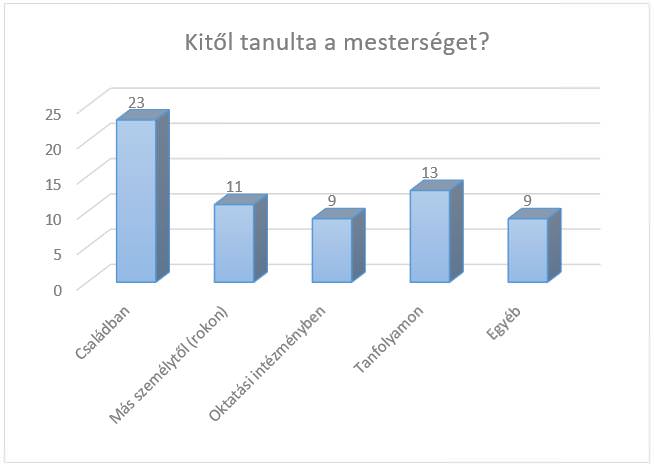
They learned the crafts and small crafts already in their childhood in the family or from other close relatives. Apart from the family, the interviewees acquired the knowledge in an educational institution or in courses. In the "Other" category museum visits, summer camps and individual study were listed. (More than one answer could be selected for the question.)
Figure 1. Distribution of the answers to the question "Who did you learn the craft from?"
(Source: Author, 2020)
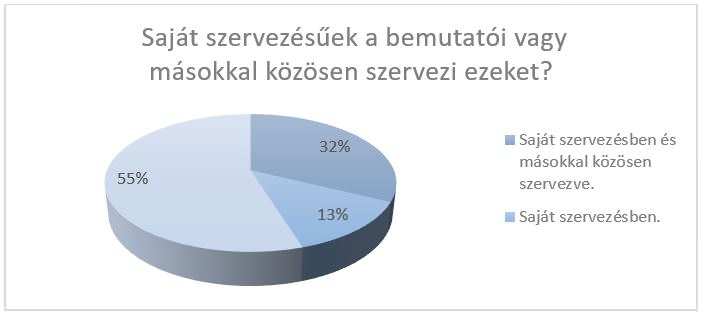
97% of the respondents stated that they would like to share and teach their professional knowledge and experience. The model of knowledge transfer within the family is an available solution for 43% of the participants of the survey. Those who do not have this opportunity (53%) are delighted to teach those interested in the profession. Almost a quarter of the respondents, 23%, deal with students. They are the ones who can pass on the folk traditions and the love of folk art to the next generations in the form of formal education within the school system (in educational institutions) and in non-formal and informal learning scenes outside the school system (study circles, creative camps, courses, craft shows). One third of the respondents perform artefact making as a hobby. Figure 2 shows that two-thirds of the interviewed craftsmen hold workshops and take part in introduction events with greater or lesser frequency. They typically organize these events together with others in their settlements and in other villages and towns. 1% of the craftsmen take part in exhibitions and shows abroad.
Figure 2. Forms of organizing introduction events
(Source: Author, 2020)
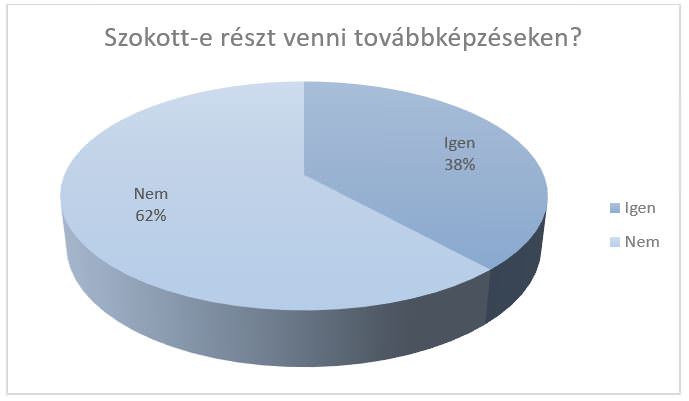
More than half of the craftsmen have their products judged, which clearly shows professional commitment, being exacting and feeling the need for development. This competition is also a good motivation force. It has an inspiring effect on learning, as well as on making new artefacts that meet the needs of today, using old traditions. This continuous learning, which accompanies folk craftsmen lifelong, manifests itself not only in the quality of the created objects, but also during the transmission of knowledge and experience and during teaching. Relatively few of the masters and junior masters train themselves, the ratio of which is shown in Figure 3. This can be due to several reasons, for instance, they do not have the right motivation or there are no opportunities for training or further training or there is a lack of non-formal and informal learning scenes.
Figure 3: Participation of craftsmen in training and further training
(Source: Author, 2020)
After the questionnaire survey, in order to be able to determine the results even more precisely and to obtain quality data, I conducted interviews with the representatives of six handicraft branches.
Each of the 6 folk craftsmen taking part in the interview study represents a different profession. Three are artisans – a potter, a bluedyer and a woodcarver – and three are small craftsmen – an embroiderer, a cornhusk spinner and a folk bead jewellery maker. During the interviews, I asked the craftsmen about their history of acquiring the crafts or small crafts, the scenes of non-formal and informal learning, methods of transmitting knowledge, making it attractive to the younger age group, and the coexistence of value preservation and modernization. I summarize the results of the investigation by analyzing their answers.
Formal, non-formal and informal learning activities appeared during the acquisition of folk crafts. The woodcarver and embroiderer acquired the knowledge within the framework of formal education (vocational secondary school), while the potter gained the knowledge in an educational institution, during adult training. And two small craftsmen (a cornhusk spinner and a folk bead jewellery maker) learned the trade during summer camps, courses and self-training. Only a few craftsmen (bluedyer, woodcarver) had access to knowledge transfer between generations. Even after mastering the basics, craftsmen continue to learn and expand their knowledge. As for the non-formal and informal learning scenes, craft fairs, presentations, courses, summer camps organized for the profession were mentioned as well as museums as ethnographic collections. At the invitation of educational and cultural education institutions and civil organizations, they hold craft classes and workshops, in which both young and adult age groups take part. They expressed the demand for the establishment of a Creative House, where creation and knowledge transfer could take place in a community. It is very important for artisans to be able to hand down their crafts and small crafts. They urged the introduction of craft traditions and the active involvement in the process of creation from childhood.
Almost all of them regard modernization (creating artefacts that meet the needs of today and preserve the traditions of the past at the same time) as the guarantee of the survival of handicraft professions. In addition to books, films, and educational events, they also consider the positive impact of the creators' personality and their love of the profession to be important.
Summarizing the empirical research, we can conclude that both the questionnaire survey and the interview study revealed that transferring the love, practice and the approach of creation must start from childhood. And further learning and gaining experience will be a lifelong process for the future creators - if a profession really gets close to their hearts.
The research revealed that craftsmen and those transferring knowledge do not represent a completely overlapping target group. As one of them indicated, there are good craftsmen, but not all of them are good knowledge transmitters. (For this reason, it would be worth accrediting the knowledge base, and especially the method necessary for teaching and learning the craft, especially for children.) One way of transferring knowledge is to have students beside the folk craftsmen. The location of the master's work is his own workshop, which is also a scene for transmitting knowledge. In addition, the craftsmen of the county often hold introductory sessions and camps outside the workshop in many cases. One area of our research was to review the informal and non-formal training locations of the county. Perhaps one of the most neglected training locations in terms of usage is the heritage house museum. Heritage house museums have been established in dozens of settlements in the county, however, in most of them, only the exhibition space functions. There are only a few events that can achieve the promotion of crafts in the triad of knowledge - creation - transfer, and can address and retain those interested. This spare capacity for informal and non-formal craft trainings is still available in the county. Primarily there is a need for organizing skill to generate demand, that is, give the chance for young people to get impressions from authentic people, in authentic places and in ethnographically authentic ways. That is why it is definitely desirable to achieve the following goals with the involvement of the stakeholders.
The Open Workshops learning scene should be extended. The Open Workshops and Gates include a wider set of crafts than the former. In addition to the manufacturing work it also covers the topic of local food processing. The local economy is concerned in the utilization and operation of local resources on the spot. In consequence, local profits also remain local. A classic example is the development of regional tourism and the forming a system of those working in it.
In Győr-Moson-Sopron county, these Craft workshops have not yet been organized into a network, although there have been initiatives. Tourism is one of the bases of sustainability. In this case, the supply of accommodation and catering services, as well as attractions and programs, represents the supply portfolio that attracts the guests to the area. The areas of the county frequented by tourists and the location of the folk craftsmen do not overlap geographically. This reason alone necessitates networking. On the other hand, this area is one of the strengths of the Rábaköz region, which is rich in folk crafts and small crafts. In this way, the positioning of the region as a handicraft tourist destination can be a real development goal, therefore, the craftsmen and trainers must join their forces.
Craftsmanship is more than a profession. Basically, it is a procedure that moves both hemispheres of the brain, a process, where knowledge and creation must coexist with the ability of creativity and intuitive vision. The individual interviews reflect this perspective and this ability to empathize. This empathic approach and behavior make the creator unique as well as the result of the creation. All the interviewees conveyed the message of their mission about the goal of mastering the craft in a thought-provoking and convincing way: "Preserving the tradition of our nation for posterity." Folk craftsmen and small craftsmen fulfill a mission today, just as they have always done in the past centuries. It is up to us, the people living today, to ensure that this intellectual - spiritual - material continuum is preserved for the future.
Conclusions and recommendations
The findings of my research:
- There has been a sharp decline in folk small crafts over the past 40 years. The survival of the crafts was either due to a strong identity or their contribution to making a living.
- Even today, non-formal and informal learning is significant in the transmission of the knowledge base of small handicrafts.
- Inner drive is significant in acquiring this knowledge and practicing the craft. It is possible to strengthen this commitment.
- Attachment to the craft has different levels in terms of quality and strength: hobby, semi-professional (earning additional income), doing arts and crafts for a living.
- The past roots and future strength of a nation, country, region, settlement are shown by the ability and willingness to preserve them.
- This way, the social role of folk crafts helps self-identity.
It is outside the subject of my research, but the outbreak of the COVID-19 pandemic provides an opportunity for interesting observations. The acute natural disaster drastically affects everyday life, now I will only highlight its impact on training and knowledge acquisition. On the one hand, the entire formal education sector immediately took a different direction. On the other hand, being confined to homes also affects informal, non-formal learning needs and compulsions. Social media shows that many people are looking for new knowledge and new solutions in the direction of knowledge acquisition and community building. Many try their hand at arts and crafts, gardening, cooking, and many other, but especially creative, activities and fields. This is beneficial because in many cases people get to know themselves from a new perspective and surprise their surroundings with the results and, thanks to the virtual network, their wider audience as well. The situation makes everyday people come up with creative and innovative solutions.
Specific proposals and points of intervention for the near future:
- At the regional (county) and local (region, settlement) level, it would be worth setting up an inventory of crafts. Those who once gained personal experience of certain handicrafts are still alive. It would be important to document them with present tools. The Committees of the Collections of Hungarian Values and other tradition preservation communities can also participate in this work.
- Research should be carried out on knowledge and identity in educational institutions among children and youngsters. Those acquiring the craft will emerge from them.
- It would be worth compiling thesis recommendation lists for university students in the field of folk crafts. It is necessary to develop sets of topics that, by virtue of their size, enable the perfect completion of a scientific work integrated in research. Discovery must be started at the settlement level, and then the proposed topics must be sent to the concerned departments of the higher education institutions.
- In the county of Győr-Moson-Sopron, in order to teach children, summer camps and craftsmen should be organized in a network. In order to facilitate this, it is advisable to create a county craft website in cooperation with the rural development organizations or the gestor association.
- It would be useful to develop more, but smaller projects in order to fill the townhouses of the county with life and events, for instance: public holidays, craft days, value display forums.
- Close cooperation with the 4 Leader organizations of the county would help strengthen this crucial element of rural development in preparation for the new EU development cycle (2021-2027). The professional and financial planning period is starting now, so you can certainly build on the topicality of the case. The host of the topic is the trade association of craftsmen as well as the Chamber of Commerce and Industry of Győr-Moson-Sopron County.
- It would be necessary to organize further trainings, study tours and exhibitions for each target group: hobbyists, semi-professionals, professionals. This should be done in two ways. Partners from other regions can be invited to events held in the county. At the same time, the locals must be taken to other regions, such as the frequented regions of the Carpathian Basin and Europe.
Given that I work in the filed of cultural education and community development, I would like to devote my energy to deal with some of the above topics and represent them in various professional platforms of the county.
References:
- Forray R., Katalin – Juhász, Erika (2009): A felnőttkori autonóm tanulás és tudáskorrekciós elköteleződés. In: Forray R., Katalin – Juhász, Erika (szerk.): Nonformális – informális – autonóm tanulás. Debrecen, Debreceni Egyetem.
- Komenczi, Bertalan (2001): Az Európai Bizottság memoranduma az egész életre kiterjedő tanulásról. In: http://epa.oszk.hu/00000/00035/00050/2001-06-eu-Komenczi-Europai.html Letöltve: 2021. február 18.