
Edina Gróf-Mohos: The Changing Nature of Career Guidance in the Training Field for Community Culture (namely Community Coordination BA) – A brief historical overview of theories defining career guidance practice and the initial findings of doctoral...
DOI szám: https://doi.org/10.64606/ksz.2025205Cikk letöltése: pdf
2025-12-22

Absztrakt: A megfelelő életpálya, azon belül a szakma, hivatás, a sikeres foglalkozáspálya megtalálása mindig is nehéz, nagy kérdés volt a fiatalok számára, de a problémakör számos vetülete a kutatókat is foglalkoztatja. Mai, modern, gyorsan változó és kiszámíthatatlan világukban a pályaválasztás még nehezebb, mint korábban, mert nem egyszeri eseményről, hanem – a tanuláshoz hasonlóan - egész életen át tartó, komplex folyamatról, az életutat végig kísérő döntések láncolatáról van szó. Nem véletlen, hogy ma már nem pályaválasztásról, hanem pályaorientációról és élethosszig tartó életpálya tanácsadásról beszélünk (lifelong guidance- LLG). Igaz ez azokra a fiatalokra is, akik a kulturális élet területén képzelik el a jövőjüket, legyen az a közösségszervezés, a művészeti élet, vagy a szabadidőipar területe. Ezen szakmák esetében is kiemelten fontos a megfelelő a pályaorientáció, az életpályatanácsadás, valamint az ezek mögött húzódó elméleti és gyakorlati kérdések is, mindezek hozzájárulhatnak a motivált szakemberek toborzásához, képzéséhez és későbbi megtartásukhoz is.
A pályaorientáció problémakörére, gyakorlatára vonatkozóan számos elmélet született, azonban az értelmezés kérdésében még nincs konszenzuson, egyetértésen alapuló definíció. Ennek fő oka az, hogy az életpályaépítés, a karriertervezés kérdésköre interdiszciplináris terület (Borbély-Pecze, 2024), így minden tudományterület a saját megközelítése felől vizsgálja a problémakört. Napjainkban is számos szervezet foglalkozik pályaorientációval, így felmerülhet a kérdés, hogy a pályaorientációt segítő szolgáltatások - egységes definíció és koncepció hiányában - milyen megközelítéseken alapuló korábbi elméletekre és modellekre épülnek, s melyek bizonyulnak sikeresnek a mai, gyorsan változó munkaerőpiaci környezetben és speciálisan a közművelődés területén. Jelen tanulmány ezen probléma körül járásához kíván hozzájárulni néhány történeti és újabb pályaorientációval kapcsolatos elmélet, modell és módszer áttekintésével, néhány hazai szervezet honalapjának elemzése révén nyert megállapításokkal és egy közösségszervező szakosok egyetemi hallgatók körében végzett, szakválasztással foglalkozó doktori kutatás első eredményeinek bemutatásával.
Abstract: Finding the right career path, including a profession, a vocation, and a successful occupation, has always been a difficult and significant question for young people, and various aspects of this issue also attract the attention of researchers. In today's modern, fast-changing and unpredictable world, choosing a career is even more difficult than before, because it is not a one-time event, but - like learning - a complex lifelong process, a chain of decisions that accompany the entire life journey. It is no coincidence that we no longer talk about career choice, but about career guidance and lifelong guidance (LLG), the need for which is confirmed by everyday economic practice. This also applies to young people who envision their future in the field of cultural life, whether it be community organizing, the arts, or the leisure industry. In the case of these professions as well, an appropriate career guidance, a career counseling, and the theoretical and practical issues behind them are of paramount importance, since they can contribute to the recruitment, the training, and the subsequent retention of motivated professionals.
Several theories have been developed on the problem and practice of career guidance, but there is no consensus on the definition of the term. The main reason for this is that the issue of career development and career planning is an interdisciplinary field (Borbély-Pecze, 2024), so each discipline has its own approach to the problem. Nowadays, numerous organizations deal with career guidance, so the question arises as to what approaches previous theories and models are based on, in the absence of a uniform definition and concept, and which ones prove successful in today's rapidly changing labor market environment, especially in the field of community culture. This study aims to contribute to addressing this problem by reviewing several historical and more recent theories, models, and methods related to career orientation, presenting conclusions obtained from analyzing the websites of several Hungarian organizations, and presenting the initial results of doctoral research conducted among university students majoring in community coordination on the topic of career choice.
Gróf-Mohos Edina: Eötvös Loránd Tudományegyetem
The historical evolution of the concept of career guidance
The interdisciplinary and complex nature of the field makes it difficult to interpret career guidance, as there are many definitions in the academic literature and the public discourse, reflecting the authors' perspectives on their disciplines and backgrounds. Some international and national concepts of career guidance - presented below without claiming completeness - illustrate the current practice of career guidance. As an introduction, here is a comparative table of some of the concepts of career guidance that reflect Hungarian and EU practice in the context of lifelong learning. From an andragogical perspective, we consider it particularly important to emphasise the lifelong nature of the career guidance process (Table 1).
Table 1. Some prominent Hungarian and international definitions of career guidance.
Source: edited by the author, 2025
(Szilágyi, 2023; Borosán, 2011; OECD – Európai Bizottság, 2004; Szilágyi, 2005 alapján; EU Tanácsának állásfoglalása, 2004)
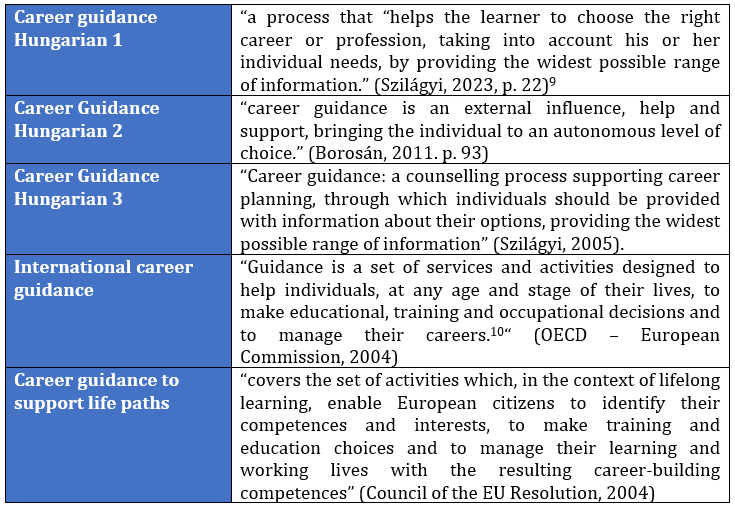
In addition to the different perspectives, the definition of career guidance is further complicated by linguistic difficulties, as there is no English equivalent for the rich Hungarian terminology. While English typically uses a single term – career guidance – to cover a range of related concepts, Hungarian distinguishes between three different terms: pályaválasztás (career choice), pályaorientáció (career orientation), and életút-támogató pályaorientáció (lifelong career guidance). (Institute for Research and Development in Education, 2014; Hegyi-Halmos, 2018).
In the following, we present some theoretical approaches to these concepts, from the first career guidance model to those used in practice today.
Early theories on career guidance
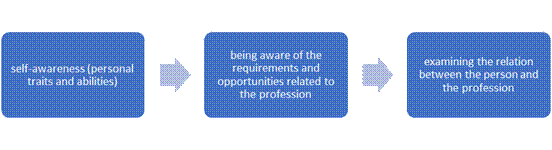
Frank Parsons was the first early theorist to focus on psychological aptitude by comparing personality with the requirements of the job. He examined whether there are personality traits suited for certain professions, and whether these traits can determine if a person is suitable for a given job or not. According to Parsons, the process of career guidance is as follows: (Figure 1).
Figure 1: The process of career guidance according to Parsons' theory of psychological aptitude.
Source: own ed., 2025 (based on Parsons, 1909)
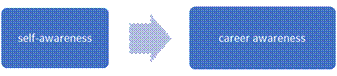
In the first step, he included consideration of abilities, skills, interests, resources, ambitions and limitations, all of which he considered worthy of comparison with the relevant requirements of the occupation (Parsons, 1909). In developing his theory of typology, Holland took a similar approach, arguing that each job has a particular personality type and that personality types should be taken into account in the context of the workplace when choosing a career. He distinguished six personality types: Realistic, Investigative, Artistic, Social, Enterprising, and Conventional. The typologies differ in terms of their personality structure, behavioural patterns and reactions. It is important to underline that, according to Holland, people of the same typology show typical patterns. Holland's approach understands career guidance as a process of two stages, self-awareness and career awareness (Holland, 1997) (Figure 2).
Figure 2: The process of career guidance according to Holland's typology
Source: own ed., 2025 (based on Holland, 1997)
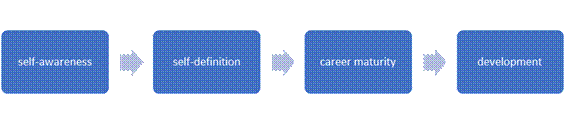
Among the great theorists, Super approached career guidance from several directions, and throughout his career, he modified his early claims. Super's early, first developmental approach was concerned with the whole career. His starting point was that people are different, and he believed that each person could be suited to several professions. In his developmental psychology theory, he considered it important to take into account the personal qualities of the individual, but he also looked at external, environmental factors, such as economic or family circumstances. He built his theory on career maturity, emphasising that career satisfaction depends on personality, interests and abilities. In the process of career guidance, he emphasised the importance of self-awareness as the first step, followed by self-definition and then career maturity. The final stage, the end of development, is not clearly definable, as development is present throughout the five stages of the career (Growth, Exploration, Establishment, Maintenance, Decline) that he identified (Super, 1953) (Figure 3).
Figure 3: The process of career guidance according to Super's theory of developmental psychology.
Source: own ed., 2025 (based on Super, 1953)
Super's later work, known as the Rainbow theory, dealt with the importance of roles. On the career path, he distinguished eight roles, the importance of which changes with age. At this time, he identified career choice as a decision point, but he did not consider the choice to be final. This model also included internal aspects such as the importance of interests and skills (Super, 1980; Borbély-Pecze - Répáczki - Kovács, 2010; Hegyi-Halmos, 2016; Török, 2017).
In the context of Super's concept of decision point, it is also worth mentioning decision theories, including the process of career choice decision, which has been mentioned in several studies (Tiedemann and O'Hara, 1963; Ries, 1970; Lange, 1978; Busshoff, 1989). In this paper, it is not possible to discuss them in detail, but it is important to mention Ries' work. In his approach, career choice is a rational decision-making process aimed at the elimination of an existing state (Ries, 1970, as cited in Hegyi-Halmos, 2016). This state can be either a state of uncertainty, a phase of pathfinding or even a life situation that can be changed by finding the right career. Ries divides the decision process into five parts, the first of which is the recognition of the uncertainty, i.e., the identification of the starting point (Figure 4).
Figure 4: The process of career choice according to Ries' theory.
Source: own ed., 2025 (based on Ries, 1970, as cited in Hegyi-Halmos, 2016)

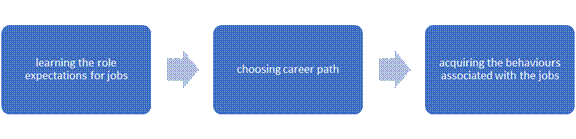
The concept of roles was previously mentioned in connection with Super's Rainbow theory. Danheim (1967), in a different approach, also addressed the concept of roles in his theory of career socialisation, according to which every career has role descriptions that must be met and embraced. For Darheim, the process of choosing a career begins with learning about these role models, and then the individual chooses the right career and adapts to the behaviours required for it (Figure 5).
Figure 5.: The career decision process according to Danheim's career socialisation theory Source: own ed., 2025 (based on Danheim, 1967)
According to Musgrave's (1967) theory of career socialisation, the acquisition of career-related social roles, which individuals can acquire through latent role learning, accompanies the entire career path. He divided the process into three parts and emphasised pre-career socialisation as a starting point, but saw the acquisition of professional socialisation as achievable through entering the work field and gaining practical experience. (Figure 6).
Figure 6: Process of career socialisation according to Musgrave's theory Source: own ed., 2025 (based on Musgrave, 1967)

The theories presented above do not cover all the work done to define career guidance, however, their approaches form the basis of today’s usage of concepts in career guidance practice.
Modern theories of career guidance
The dominant career guidance theories presented above were developed in a different economic and historical context. In the last decades, due to globalisation, changes in the world of work and the shift in lifestyles, new career guidance theories have emerged. Further shaped by the mandatory regulations that defined lifestyle during the COVID-19 pandemic. (Borbély-Pecze, 2024). The earlier claim that one-time decisions taken in adolescence have a lifelong impact is no longer true, as career planning has become a much more flexible process. According to Tibor Borbély-Pecze, 'Theories of career choice and career planning that were created for the classical world of wage labour are now outdated, so we need to reinterpret the concepts of modern career building and career development' (Borbély-Pecze, 2024, p. 195).
Modern career guidance theories take two new things into account compared to earlier theories. On the one hand, they focus on the whole person, not only on skills, but also on development for successful career guidance. On the other hand, they take into account the flood of information available, the noisy and overloaded channels of communication in which the individual seeking a path today has to navigate. The situation is now more complex than it was when the earlier theories were formulated.
To understand this complexity, we must also consider the broader social context. Late modern social theories—such as concepts related to post-industrial, knowledge-based, postmodern, late modern, and risk societies—all emphasize the breakdown and transformation of linear life paths, stable social roles, and predictable development trajectories (Giddens, 1991; Beck, 1992; Bauman, 2000). These approaches point out that uncertainty, transience, and constant adaptation have become defining characteristics of contemporary social functioning, which fundamentally transforms ideas about careers and career orientation and contributes to the emergence of nonlinear, adaptive career theories such as the chaos theory approach.
These changes call for a rethink of the concepts of career guidance as described above. From the point of view of content, it is necessary to distinguish between what is meant by career guidance in childhood, adolescence and adulthood (Borbély-Pecze, 2024).
In summary, it can be stated that according to modern theories, career guidance can no longer be identified as a one-time, lifelong decision, but rather as a phased career path preparation, interspersed with changes (Borbély-Pecze, 2024). Justify raising the question of whether the challenging steps of career guidance theories presented earlier are valid for both the guidance profession and those seeking guidance. In response, Pryor and Bright (2011) applied chaos theory, familiar from the natural sciences, to the field of career guidance. Chaos theory is based on non-linearity, attributes an important role to chance, and emphasises unpredictability and the availability of limited control. They argue that flexibility, creativity, adaptability and persistence are among the qualities and skills that become key to an individual's career development (Pryor - Bright, 2011). Another important new approach is that these theories consider the individual from a modern perspective, taking into account the environmental and social interactions surrounding them, including economic and cultural systems. (Pryor - Bright, 2014; Borbély-Pecze, 2024).
Recent theories suggest that career planning needs to go beyond the past, because future planning cannot be based on past information. Thus, Pryor et al. suggest developing personal strategies, including awareness of opportunities, persistence and resilience. They also highlight the importance of adaptability, creativity and innovation (Pryor - Bright, 2011).
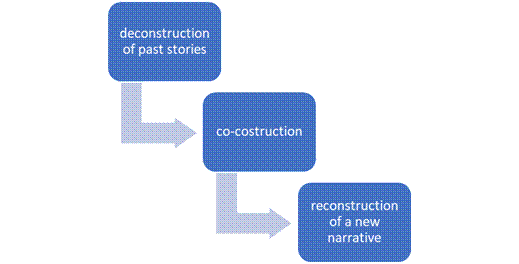
A narrative perspective has emerged from the modern approaches in career guidance counselling. It is based on the collaborative meaning-making between the client and the counsellor, shifting the emphasis from the diagnostics and test results towards a deeper understanding of the individual’s life story. According to this approach, the career guidance process consists of three phases: deconstruction of past stories, their new shared interpretation, i.e., co-construction, and finally reconstruction of the new narrative (Figure 7). The last one is the starting point for career moves (Savickas, 2005; Savickas, 2019; Borbély-Pecze, 2024).
Figure 7: The steps of career guidance according to the narrative approach.
Source: Own ed., 2025 (Savickas, 2005)
Savickas is credited with the theory of career construction based on constructivist psychology, which approaches careers not as a predetermined path but as a subjective, constantly evolving story. Savickas is also concerned with personality types. However, instead of viewing them as predicting factors, he interprets them as determinants of possible career paths, and the individual's task is to give meaning to their life path based on these. In practice, career narratives help to identify the patterns along which an individual's career decisions and patterns of adjustment can be interpreted (Savickas, 2005; Savickas, 2019; Borbély-Pecze, 2024).
Analysing the theories presented above, we can see that, compared to the previous ones, chance, flexibility and adaptability play a greater role, and the importance of counsellor support and targeted interviews is highlighted in terms of career guidance.
Some characteristics of the career guidance practices of Hungarian organisations - based on an analysis of websites
In the context of an overview of early and modern theories, it is also relevant, without claiming completeness, to look at the career guidance process in the practice of some Hungarian organisations. To this end, we examined the websites of five randomly selected public, private and non-profit organisations. First of all, we wanted to know how career guidance is understood at the level of the process. Therefore, we looked for specific, clearly distinguishable steps similar to the diagrams used to present the theories, and then used the process descriptions we found to create Table 2. On the websites examined, the steps of career guidance were mostly presented in a form of lists, sometimes presented in a way that followed from the definition and description of the concept itself. Three of the sources examined belonged to public organisations (OFI, Nemzeti Pályaorientáció Portál, Székesfehérvári Szakképzési Centrum), one to a foundation (Miénk a Pálya Alapítvány) and one was an online game interface for career guidance, thus representing the market side (Pályaválasztás Online). During the study, we consciously aimed to present practical steps found on the websites of public, non-profit and private guidance providers. The selection is characterised by an emphasis on public organisations, the reason being that we found little relevant information on the website pages of individual advisers.
The Hungarian Institute for Educational Research and Development ‘HIERD’ (Oktatáskutató és Fejlesztő Intézet ’OFI’ ) ceased to exist in 2019 and its tasks were taken over by the Education Authority (Oktatási Hivatal). The website under review contains archive material, including a section on career guidance. On the website under review, the issue of career guidance is presented in the context of the Education and Training Programme, with a particular focus on supporting career guidance activities in schools. The focus was on providing the necessary information, activities to help career guidance (self-awareness exercises, exploring opportunities and constraints), supporting the transition between school and work, developing programmes and support materials that can be integrated into the curriculum and school framework (ofi.oh.gov.hu).
Nemzeti Pályaorientáció Portál – Módszertani Központ is part of the Nemzeti Szakképzési és Felnőttképzési Hivatal (National Office of Vocational Education and Training and Adult Learning), and its task is to coordinate and support career guidance activities. The website was created to provide reliable, up-to-date and targeted assistance to students, parents, teachers, counsellors and other professionals. The portal provides, among other things, self-awareness questionnaires, career profiles, tutorial videos, methodological tools for professionals, guides and useful information, links and contact details (palyaorientació.nive.hu).
Székesfehérvári Szakképzési Centrum is one of the county centres of the national network, which is responsible for the coordination and professional management of local vocational training institutions. The Centre is a pioneer in the field of career guidance, as it is one of the first in the profession to create a balance between the labour market and education, and its ambition is to make career guidance a real process. They are developing new and innovative tools, such as games for career guidance and self-awareness, and they also focus on information transfer and training of professionals (palyaorientacio-szfszc-hu; fejer.hu).
Miénk a Pálya Alapítvány is a nonprofit organisation dedicated to supporting young people in their career choices, from secondary school to starting a career. The NGO supports young people's career choices through various methods, individual and group counselling, school programmes, online content, with a strong focus on helping disadvantaged groups (mienkapalya.hu).
Pályaválasztás Online, a digital platform partnered with the previous foundation, is a platform for young people to make career choices through interactive online games. The aim is to provide fast, accurate and personalised advice in a playful way (palyavalasztasonline.hu).
The following comparative table has been designed to extract information on the process of choosing a career and on the different steps of the assistance process. The strategy and structure of the concepts and process descriptions found in the public platforms are similar: starting with the development of self-awareness, followed by the exploration of pathways and options, and then, as a third step - in the case of OFI - the matching of ideas and options, while the Pályaorientációs Portál (Career Guidance Portal) prioritises labour market information. An interesting point is the mentioning of the ‘most important careers', however, the definition of the concept or the criteria for highlighting them are not provided. The Székesfehérvári Szakképzési Centrum also uses a three-step model: after self-awareness, it discusses separately the professions and the labour market, in reverse order. In contrast, the Miénk a Pálya Alapítvány and Pályaválasztás Online use a four-step structure. The former starts with self-awareness, followed by career mapping, then reflection and decision making. The latter provides support in a playful format, where a realistic self-image is the basis, followed by professional knowledge, labour market orientation and exploration of training pathways (Table 2).
Table 2: Practical steps in career guidance among institutions and professional organisations in Hungary.
Source: own editing, 2025 (based on ofi.oh.gov.hu/palyaorientacio; palyaorientacio.nive.hu;; mienkapalya.hu; palyavalasztasonline.hu;, palyaorientació.szfszc.hu)
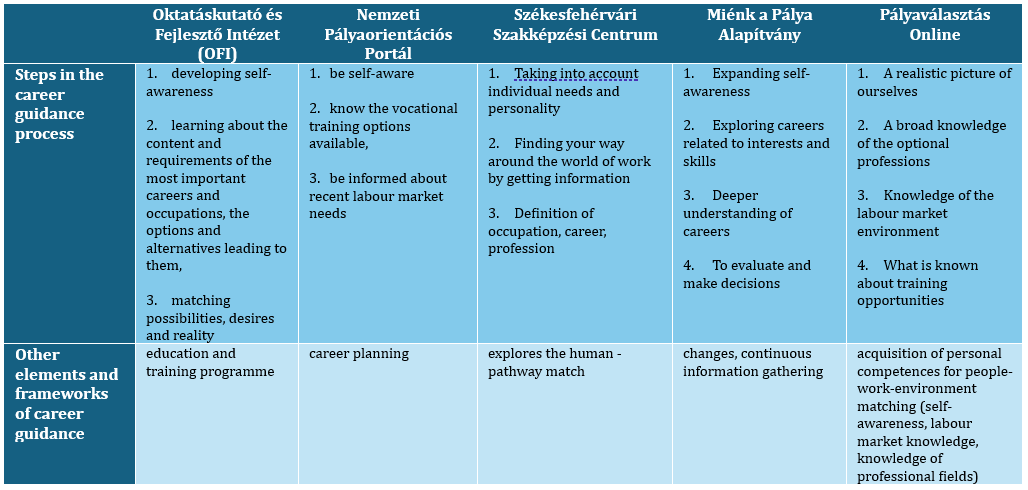
The website analyses show that the steps of career guidance programmes used by practitioners reflect theoretical approaches, such as the concept of a lifelong process (Super, 1953; Musgrave, 1967) rather than a one-time decision to plan a career (Parsons, 1909; Holland, 1997). An important experience, however, is that the newer approaches based on chaos theory, the role of chance and adaptation in the process of career guidance, do not appear on the websites studied.
Community culture specialist training and career choice - The impact of leisure activities on the choice of university major among undergraduate students studying community coordination
After reviewing career orientation theories and practices, we will look at career orientation practices based on the initial results of ongoing doctoral research and the responses of students majoring in community coordination. The aim of presenting the partial results of the research is to highlight patterns found in the students' responses that carry a direct message for cultural and community culture institutions and organizations involved in related professional training.
The target group of the doctoral research is students majoring in community coordination (BA), recreation and lifestyle (BSc), and human resources (BSc), and its aim is to explore the relationship between leisure activities and motivation for choosing a major. In this study, we focus only on the findings related to community organization majors, which were based on the questionnaire and focus group responses of first-year (N=101) and graduate students (N=6) who were surveyed. From the results of the mixed-methods research, we will briefly discuss the degree of awareness of the respondents regarding their choice of major, the ratio of internal and external motivations influencing their choice, and the relationship between leisure profiles and choice of major.
Among the students of the three bachelor's programs, community coordinators had the highest level of awareness in choosing their major, with the highest proportion (42 people) selecting the "fully aware" category in the questionnaire. An interesting finding from the perspective of our topic is that those who received the most help in their decision-making (exhibitions, career choice presentations, open days, career choice specialists, etc.) rated their choice of major as less conscious than those who did not seek help. This raises the question of the effectiveness and relevance of career guidance support.
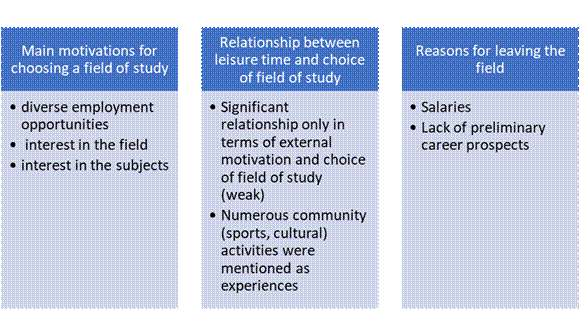
Among the first-year community coordinators surveyed (N=101), a paired sample t-test examining motivation showed that intrinsic motivation (including interest and value alignment) has a significantly strong relationship with choice of major, while extrinsic motivation is less relevant in their case (including prestige, income, labor market opportunities, etc.). The most important motivational factors are: diversity of employment opportunities, personal interest in the field, and interest in the subjects; the least influential factors are friends choosing the same major, the name of the major, and parental and family influence. Compared to the other two fields of study, based on EM means values, internal motivation is highest among community coordinators (KS: 3.4; SE = 0.0912; 95% CI: 3.25-3.61), while external motivational factors are least important to them (KS: 2.6; 0.0642; 2.44–2.70). The result confirms the preliminary assumption that young people with the strongest internal motivation apply to the community coordination program.
With regard to leisure time, according to the results of the two-way ANOVA test, intrinsic motivation shows only a weak correlation with the choice of major (F=4.5512, p=0.012, η²=0.041), while extrinsic motivation is influenced by the major (F=3.233, p=0.041, η²=0.029) and active/passive leisure background (F=5.029, p=0.026, η²=0.022 – weak). Thus, considering the trio of subject choice, motivation, and leisure activity, the study found a correlation only in relation to external motivational factors. However, in the open-ended questions of the questionnaire and during the focus group discussions, several respondents highlighted the general skill development and experiential dimensions of leisure activities, which did not directly affect motivation but contributed to their choice of profession. Based on these results, when orienting and recruiting young people to the field of community coordination or to the community coordination major, it is important to take into account that they are more likely to resonate with value- and vocation-centered messages (local community impact, social cohesion, participation) than narratives built on external motivation (labor market opportunities, prestige).
The findings of the focus group study conducted among graduates (N=6) largely confirmed the quantitative results. The graduates reported similar motivations for choosing their field of study, with many emphasizing that their hobby had become their job, while those in the labor market typically reported complex, multi-specialized careers and career paths. Half of the respondents left the field of community culture (community coordinators surveyed N=6). According to them, their innate community attitude and the professional skills they learned accompany them throughout their careers, whether they remained in the profession or left it. All three respondents cited low pay as the reason for leaving their careers, adding that they had chosen their profession based on their interest in the field, but had no career path in mind and were unaware of the labor market outcomes and opportunities.
Figure 8: Main findings regarding the career paths of community coordinators
Source: Own compilation, 2025.
Comparing the relevant results of our research with the above theoretical findings, we believe that they are most closely related to Savickas' career construction theory in that internal motivation, value alignment, and meaning-making play a central role among the community coordinators we studied. The qualitative narratives of the interviews ("my work became my hobby") all suggest that graduates construct their choice of profession as part of their own story and career. In addition, a connection can be found with Super's career development theory, as conscious choice and practical experience together shape an individual's career path and professional identity.
Overall, it can be concluded that the career image of the community organizers examined is organized in value-based, community impact-oriented narratives, and that public cultural institutions can most effectively support this with practical and reflective learning spaces, both before the choice of profession and even during university studies.
Summary
The study aimed to take a look at the well-known, popular, early and new concepts of career guidance processes in Hungary, and to analyse websites to find out, on the one hand, what theoretical foundations are used in today's guidance processes, and on the other hand, what models are used by different professional actors (public, civil, private) in their career guidance work. The overall aim was to highlight the gaps and shortcomings between theory and practice. As a good practice, the study refers to the results of a survey on career orientation conducted among students of a university bachelor's program in community coordination, which is part of the training of community culture professionals. The survey reveals the factors that may influence the choice of profession and career path, and how to approach the issues of professional career orientation and recruitment today.
In the introductory part of the paper, we summarised the main theories on the concept of career guidance, based on academic sources (Parsons, Holland, Super, Ries, Danheim, Musgrave), which typically interpreted career choice as a rational, often one-time decision or as a correspondence between personality and career, and more recent sources (Pryor and Bright, Savickas), which now emphasise the process of career guidance as a whole, the complexity of the factors influencing it and the need for continuous personal development. In Hungarian practice today, the old theoretical approaches are present and continue to shape professional thinking and day-to-day practice on career guidance, as can be seen from a pilot study of organisations' websites.
The new theories call attention to the importance of noticing and accounting for phenomena in a changing world and economy that may seem less tangible and concrete than in the past. Chaos theory, which has emerged as a result of globalisation and technological developments, emphasises the role of chance and the importance of flexibility in the career guidance process (Pryor - Bright, 2014). Narrative and career construction theories also draw attention to this, and they rely more on life stories, meaning-making and motives than in the past (Savickas, 2005, Savickas, 2019). As far as career guidance counselling is concerned, perhaps even the concept of life-course supportive guidance, which emerged in the early 2000s, does not fully cover the wide range of professional work that a guidance practitioner is now required to do in the supportive-developmental process, and it is no coincidence that the 2004 Council of the EU resolution already referred to complexity (Council of the EU, 2004).
The practical models were presented based on an analysis of resources available on the internet as a pilot study for a research project. We were curious to find out how the professionals of the different organisations - in the context of the creation of the website - thought about the process of career guidance and what theories they based their work on. Overall, it can be concluded that almost all of the models examined build on self-awareness, learning about careers and occupations, and the acquisition of knowledge about them, as well as the foundation of decision-making. However, there is little reference to the task of long-term development, to the concept of career management. It is also apparent that practitioners do not base their work on any specific theoretical approach, but rather try to build on both classical and modern theories in a complex way. The analysis on this website was intended to raise awareness of the topic, focusing on the impact of theories on practice, and we plan to conduct a more in-depth empirical study with practitioners in the future.
Overall, we can say that elements of classical career guidance theories, such as self-awareness, career awareness and decision making, are present in Hungarian career guidance practice. However, they build less on modern theoretical approaches, presumably because they are not familiar with, or have difficulty in applying, the more flexible and personalised process management methods of modern theories in practice. Nevertheless, it is believed that the procedures used in practice are based on best traditions and well-established experiences.
The career outlook of community coordination students is predominantly value-based and oriented toward community influences. The results show that the internal motivation of community students is significantly higher than their external motivation, and among the majors examined, it is highest among community coordinators. There is a correlation between leisure profile and choice of major, suggesting that students' previous leisure activities contribute to their decision to choose a major. The stories gathered during the qualitative interview research confirm the community-minded nature of the students and the role of their previous leisure activities in their choice of major, which can also be put to good use in many other areas. The results also reveal aspects of career construction and career development theory, which can and should be built upon in career orientation exercises and student recruitment.
We hope that the study has succeeded in raising awareness of the importance of the link between theory and practice, the need for career exploration and the need to adapt and evolve to constant change, which in our rapidly changing world is an essential requirement for both individuals and counsellors.
Literature/Academic sources used:
- Bauman, Z. (2000). Liquid modernity. Polity Press.
- Beck, U. (1992). Risk society: Towards a new modernity. Sage.
- Borbély-Pecze Tibor Bors– Répáczki Rita– Kovács Tibor (2010): Az életút-támogató pályaorientáció rendszerének bevezetése. http://www.afsz.hu/resource.aspx?ResourceID=afsz_tamop222_sajto_az_eletuttamogato.
- Borbély-Pecze, T. B. (2024). Életpályaépítés interdiszciplináris megközelítésben. ÚJ MUNKAÜGYI SZEMLE, 5(3), 2–10. http://doi.org/10.58269/umsz.2024.3.1
- Borosán Lívia (2011): Pályaorientáció. in.: Bábosik István, Borosán Lívia, Hunyady Györgyné, M. Nádasi Mária, Schaffhauser Franz (2011): Pedagógia az iskolában. A szociális életképességek megalapozása. Budapest. ELTE EötvösKiadó
- Busshoff, L. (1989): Berufswahl. Theorien und ihre Bedeutung für die Praxis der Berufsberatung. Stuttgart: Kohlhammer
- Daheim, H. (1967): Der Berzf in der modernen Gesellschaft, Köln
- Giddens, A. (1991). Modernity and self-identity: Self and society in the late modern age. Polity Press.
- Hegyi-Halmos Nóra (2016): AZ ISKOLAI PÁLYAORIENTÁCIÓ SZEREPE ÉS GYAKORLATA A HAZAI KÖZNEVELÉSI INTÉZMÉNYEKBEN. A pedagógusok vélekedései a pályaorientáció iskolai szerepéről a gimnáziumokban. Budapest
- Hegyi-Halmos Nóra (2018): Az életpálya tanácsadás nemzetközi trendje. in: Opus et Educatio 5. évfolyam 1. szám
- Holland, J. L. (1997). Making vocational choices: A theory of vocational personalities and work environments (3rd ed.). Psychological Assessment Resources.
- Európai Unió Tanácsa és a tagállamoknak a Tanács keretében ülésező képviselői által kialakított állásfoglalás az életút-támogató pályaorientációs szakpolitikák, rendszerek és gyakorlatok megerősítéséről) 9286/04, 2004. május 18.
- Lange, A. J. – Jakubowski, P. (1978): The Assertive option. Champaign:Research Press.
- Musgrave, P. W. (1967): Toward a sociological theory of occupational choice. Socioloical Review, 15, 33-45.
- OECD és Európai Bizottság (2004): Career guidance: A handbook for policy makers. https://www.oecd.org/content/dam/oecd/en/publications/reports/2004/12/career-guidance_g1gh4251/9789264015210-en.pdf (utolsó letöltés: 2025.06.16.)
- Oktatáskutató és Fejlesztő Intézet (2014): Összegző tanulmány az európai és hazai pályaorientációs szakpolitika pilléreiről, üzeneteiről, céljairól https://ofi.oh.gov.hu/sites/default/files/attachments/1_osszegz%C3%A9s_eu_hazai_szakpolitika_p%C3%A1lyao.pdf
- Parsons, Frank (1909): Choosing a Vocation. Gay, London. https://archive.org/details/choosingvocation00parsuoft (utolsó letöltés: 2025.06.16.) Pryor, R. G. L.; Bright, J. E. H. (2011). The Chaos Theory of Careers: A New Perspective on Working in the Twenty-First Century. Routledge.
- Pryor, R. G., & Bright, J. E. (2014). The Chaos Theory of Careers (CTC): Ten years on and only just begun. Australian Journal of Career Development, 23(1), 4–12. https://doi.org/10.1177/1038416213518506
- Savickas, M. L. (2005). The Theory and Practice of Career Construction. In Brown, S. D. & Lent, R. W. (eds.), Career development and counseling: Putting theory and research to work. (pp. 42–70). John Wiley & Sons, Inc
- Savickas, M. L. (2019). FETA Könyvek 13: Kézikönyv az élettervezési tanácsadáshoz (B. Füleki, Ed.; N. Mailáth, J. Aradi & B. Füleki, Trans.). Felsőoktatási Tanácsadás Egyesület. ISBN 978-615-80732-2-6.
- Super, Donald E. (1953): A Theory of Vocational Development. American Psychologist 8(5). 185–190
- Super, D. E. (1980). A Life-span, Life-space Approach to Career Development. Journal of Vocational Behavior, 16(3), 282–298.
- Szilágyi, K. (2005). A fiatalok és felnőttek pályaorientációs és karrierépítési készségeinek szintje, fejlesztésének lehetőségei. Budapest: Nemzeti Felnőttképzési Intézet
- Szilágyi K. (2023). Munka-, pályatanácsadás, mint professzió. Kollégium Kft
- Tiedeman, D.V. – O’Hara, R.P. (1963): Career development: Choice and adjustment. New York. College Entrance Examination Board
- Török Réka (2017): A pályadöntések mesterei. Print & Pixel House Kiadó. Budapest.
Internet resources:
- Fejer.hu – Fejér Vármegyei Önkormányzat hivatalos oldala Székesfehérvári Pályaorientációs Rendszer: https://fejer.hu/szekesfehervari-palyaorientacios-rendszer
- Miénk a Pálya Alapítvány: https://mienkapalya.hu/
- Nemzeti Pályaorientációs Portál: palyaorientacio.nive.hu
- Oktatáskutató és Fejlesztő Intézet (OFI): https://ofi.oh.gov.hu/
- Oktatáskutató és fejlesztő Intézet (OFI) Pályaorientáció: https://ofi.oh.gov.hu/palyaorientacio
- Pályaválasztás Online Interaktív önismereti kalandjáték https://palyavalasztasonline.hu/
- Székesfehérvári Szakképzési Centrum Pályaorientációs és kreatív Osztály: https://palyaorientacio.szfszc.hu/
[1] This definition was one of the first to be developed in the 1990s.